
When manufacturers and procurement teams invest in silicone kitchen tools, one of the most critical questions they must answer is whether those tools can withstand repeated physical stress over an extended product lifespan. Unlike ceramic or metal alternatives, silicone offers a unique combination of flexibility and resilience, but that flexibility must be rigorously tested before any kitchen tools enter the commercial supply chain. Validation for long-term mechanical stress is therefore not a single test but a structured engineering discipline involving multiple protocols, material standards, and real-world simulation cycles.
The validation journey for silicone kitchen tools begins at the material selection stage and extends all the way through accelerated aging tests, cyclic load simulations, and real-use functional assessments. Buyers sourcing kitchen tools for foodservice, retail, or OEM purposes need to understand what these validation stages actually involve so they can ask the right questions of their suppliers and make confident procurement decisions. This article walks through the full mechanical stress validation process that quality-driven manufacturers apply to silicone kitchen tools before they are approved for long-term use.
Understanding Mechanical Stress in the Context of Silicone Kitchen Tools
What Mechanical Stress Actually Means for Kitchen Tools
Mechanical stress, in the context of kitchen tools, refers to any physical force that deforms, bends, stretches, compresses, or fatigues a material during normal use. For silicone kitchen tools, this includes forces applied during stirring, scraping, pressing, bending, gripping, and even repeated washing cycles. Unlike static loads, the stresses encountered in daily cooking use are dynamic and repetitive, meaning the material must recover its shape and structural integrity after each force event.
Silicone is a viscoelastic polymer, which means it has properties of both a viscous liquid and an elastic solid. This dual nature makes it excellent for kitchen tools because it absorbs stress rather than cracking under it. However, this same property means that improper formulation or inadequate curing can lead to creep, permanent deformation, or surface degradation over time. Validation protocols are designed precisely to detect these failure modes before the product reaches end users.
The mechanical stresses relevant to kitchen tools are categorized as tensile stress, compressive stress, shear stress, and fatigue. Each of these affects the silicone differently, and a complete validation program must account for all of them. When only one stress type is tested, the resulting data gives an incomplete picture of how the product will actually perform over its intended lifespan.
Why Long-Term Validation Is Different from Short-Term Quality Checks
Many manufacturers perform basic quality checks on kitchen tools, such as hardness testing or a single bend test, before shipment. While these checks are useful, they do not constitute long-term mechanical validation. Long-term validation requires simulating the cumulative effect of thousands or even tens of thousands of stress cycles across varying temperatures, contact media, and physical conditions.
A silicone spatula that passes a single bend test may still fail after 500 uses if the silicone compound was formulated with an insufficient crosslink density. Similarly, kitchen tools that perform well at room temperature may exhibit accelerated fatigue when exposed to the thermal cycling between a hot oven environment and cold dishwasher rinse cycles. This is why long-term validation incorporates time, temperature, and repetition as core variables rather than simply testing a product once under controlled conditions.
For B2B buyers, understanding this distinction is commercially important. Products that carry only basic inspection certifications may not have undergone the mechanical endurance testing that separates truly durable kitchen tools from those that will generate warranty claims, returns, and reputational damage after extended use in commercial or household environments.
Material-Level Validation Before Manufacturing Begins
Silicone Compound Selection and Mechanical Property Benchmarking
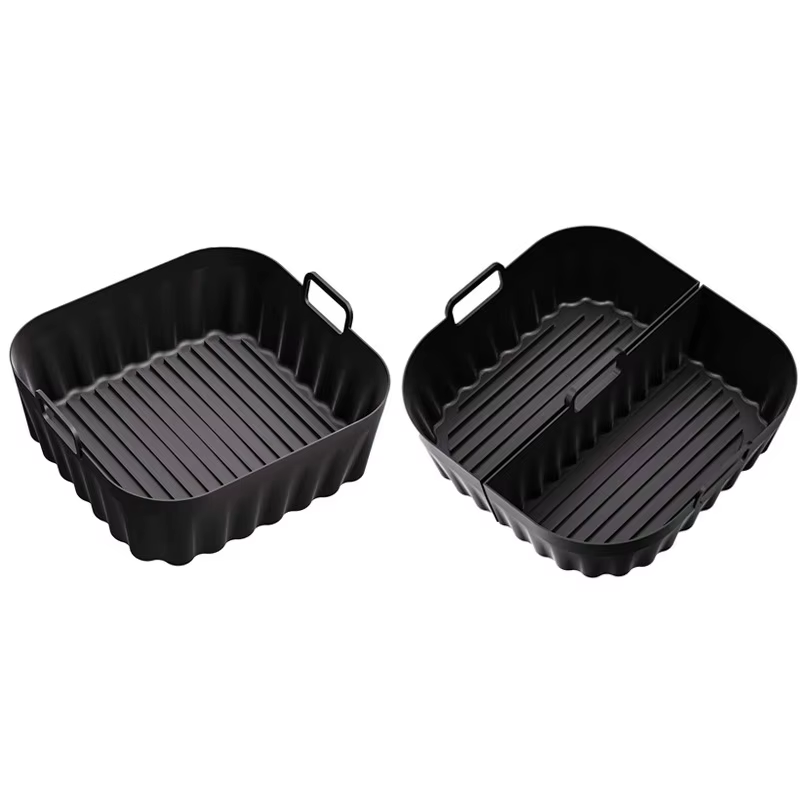
The validation of kitchen tools for mechanical stress starts before a single mold is filled. Silicone compounds used for kitchen tools are characterized by their Shore A hardness rating, tensile strength, elongation at break, and tear resistance. These properties are documented in technical data sheets and serve as the baseline against which long-term performance degradation is measured. Reputable manufacturers select compounds that meet specific mechanical benchmarks required by the application type, whether it is a flexible spatula, a rigid baking mold, or a multi-compartment air fryer tray.
For kitchen tools that will be exposed to repeated high-temperature use, the silicone compound must also demonstrate thermal stability, typically rated between -40°C and 230°C or higher for food-grade applications. The thermal stability of the polymer backbone directly influences how the material behaves under mechanical stress at elevated temperatures. A compound that softens excessively at 180°C will show accelerated creep and dimensional instability under the physical load of a user pressing down during cooking.
Material-level validation also includes extractables and leachables testing, which, while primarily a food safety concern, has mechanical implications. If a silicone compound contains excessive plasticizers or low-molecular-weight oligomers, those components may migrate out of the material over time, altering its mechanical properties and causing stiffness changes, surface tackiness, or brittleness. Kitchen tools validated at the compound level are far less likely to experience these long-term degradation patterns.
Crosslink Density and Its Role in Fatigue Resistance
Crosslink density is one of the most important but least discussed parameters in the production of durable kitchen tools. In silicone polymers, crosslinks are the chemical bonds that connect polymer chains together, creating the three-dimensional network that gives the material its elasticity. A higher crosslink density generally results in a harder, less deformable material, while a lower crosslink density produces a softer, more flexible product. For kitchen tools, the optimal crosslink density must balance flexibility with fatigue resistance.
Under-cured silicone, which has insufficient crosslinks, will exhibit compression set and creep under sustained mechanical loads. This means kitchen tools made from under-cured silicone will gradually lose their original shape over time and will not spring back fully after each use. Manufacturers validate crosslink density through compression set testing per ASTM D395 or ISO 815, which measures how much a silicone sample permanently deforms after being held in a compressed state for a defined period and then released.
Post-curing processes also affect crosslink density and, consequently, the mechanical endurance of kitchen tools. Secondary oven curing at elevated temperatures completes the crosslinking reaction and drives out residual volatile compounds, producing a more dimensionally stable and mechanically robust material. Manufacturers who skip post-curing may produce kitchen tools that appear acceptable initially but perform poorly under long-term stress conditions.
Cyclic Load Testing and Fatigue Simulation Protocols
Designing Realistic Stress Cycles for Kitchen Tool Validation
Cyclic load testing is the cornerstone of mechanical stress validation for kitchen tools. The objective is to simulate the repetitive physical forces that a tool will encounter during its expected service life and to measure whether the material and construction retain acceptable performance characteristics after those cycles are completed. The design of the test cycle must reflect the actual use case of the specific kitchen tool being validated.
For a silicone baking tray or air fryer accessory, relevant stress cycles include repeated filling with food-weight loads, thermal expansion and contraction cycles in the oven or air fryer, and mechanical flexing during food release and cleaning. For spatulas and scrapers, the relevant cycles involve bending and torsional loads applied at the junction between the silicone head and the handle insert. Each type of kitchen tool has a distinct stress profile, and the test protocol must be engineered to match it.
Industry standard cyclic testing for kitchen tools typically involves a minimum of 1,000 to 10,000 stress cycles depending on the application and expected product lifetime. At defined intervals, the test sample is removed and evaluated for dimensional changes, surface cracking, delamination, or other signs of fatigue. A product that maintains its specified dimensional tolerances and surface integrity throughout the full test sequence is considered to have passed the cyclic load validation phase.
Accelerated Aging as a Proxy for Real-World Longevity
Because it is impractical to test kitchen tools over their full five-to-ten-year commercial lifespan in real time, manufacturers use accelerated aging protocols to compress time and predict long-term mechanical behavior. Accelerated thermal aging involves exposing kitchen tools to elevated temperatures for defined periods, with the relationship between temperature and aging rate governed by the Arrhenius equation. This approach allows engineers to estimate the mechanical condition of a product after several years of normal use based on a few weeks of elevated temperature exposure.
For silicone kitchen tools intended for oven or air fryer use, accelerated aging protocols may involve continuous exposure at 200°C or higher for 72 to 1,000 hours, followed by mechanical testing to compare properties before and after aging. The parameters monitored include tensile strength retention, hardness change, elongation at break, and surface condition. A well-formulated silicone compound used in quality kitchen tools will typically retain more than 80% of its original tensile strength even after aggressive thermal aging cycles.
Hydrothermal aging, which combines heat and moisture exposure, is also applied to kitchen tools that will regularly undergo dishwasher cleaning. Repeated exposure to hot steam and alkaline detergents creates a distinct stress environment that can hydrolyze silicone bonds in poorly formulated materials. Validation data from hydrothermal aging tests gives buyers meaningful assurance that kitchen tools will not degrade prematurely when subjected to routine commercial or household cleaning regimes.
Structural Integrity Testing at the Component Level
Handle-to-Head Bond Strength in Multi-Component Kitchen Tools
Many silicone kitchen tools are composite products, combining a silicone functional element with a nylon, stainless steel, or polypropylene handle. The bond or overmold interface between these dissimilar materials is a critical stress concentration point that requires dedicated mechanical testing. Peel strength tests, pull-out force tests, and shear adhesion tests are commonly applied to validate that this interface will not fail under the mechanical loads typical of cooking and food preparation activities.
For kitchen tools where the silicone is overmolded directly onto a substrate, the adhesion bond must remain intact through thousands of thermal cycles and mechanical deflections. Bond failure at this interface is one of the most common long-term failure modes seen in lower-quality kitchen tools, where insufficient surface preparation or incompatible primer systems produce an initial bond that deteriorates rapidly under real-world conditions. Proper validation requires testing the bond at elevated temperatures and after aging cycles, not just under ambient room temperature conditions.
When kitchen tools are designed for commercial foodservice use, the bond strength requirements are typically more demanding than for consumer products because the frequency of use, cleaning intensity, and applied forces are all significantly higher. Manufacturers serving the foodservice channel should be prepared to provide test data demonstrating that their kitchen tools meet minimum peel and pull-out strength thresholds under thermally and mechanically aged conditions.
Dimensional Stability and Tolerance Retention After Stress Cycles
Beyond raw strength metrics, the dimensional stability of kitchen tools after mechanical stress cycles is an equally important validation criterion. Kitchen tools must maintain their functional geometry to perform correctly. A baking mold that warps after repeated oven cycles will produce inconsistently shaped food items, and a spatula that develops a permanent bend will lose its utility for scraping flat cooking surfaces. Dimensional stability testing measures how closely a tool's geometry conforms to its original specification after being subjected to defined mechanical and thermal stress protocols.
Measurements are typically taken at multiple points across the product using calibrated coordinate measurement equipment or structured light scanning. The allowable dimensional deviation varies by product type, but kitchen tools intended for precision baking applications, such as multi-compartment tart trays, are held to tighter tolerances than general-purpose scrapers or trivets. Products that exceed the permitted deviation threshold after stress testing must be reformulated or redesigned before proceeding to production approval.
For kitchen tools used in air fryers and similar high-temperature appliances, the combination of thermal expansion from heat and mechanical load from food weight creates a compound stress environment. Manufacturers who have not specifically validated their products under these combined conditions may inadvertently supply kitchen tools that deform in use, creating both functional and food safety concerns. Dimensional stability data from combined thermal and mechanical stress protocols is therefore a strong indicator of product quality.
Certification Standards and Documentation for Mechanically Validated Kitchen Tools
Relevant International Standards Applied to Kitchen Tool Validation
The mechanical validation of kitchen tools is supported by a framework of international standards that define test methods, acceptance criteria, and documentation requirements. Key standards applicable to silicone kitchen tools include ASTM D412 for tensile properties, ASTM D395 for compression set, ASTM D624 for tear resistance, and ISO 37 as an international equivalent for tensile testing. These standards ensure that test results are reproducible, comparable across laboratories, and credible to buyers and regulatory bodies worldwide.
Food contact compliance standards such as FDA 21 CFR, EU Regulation 10/2011, and LFGB in Germany impose requirements on the chemical composition of silicone used in kitchen tools, but they also indirectly affect mechanical validation by restricting the range of additives and processing aids that can be incorporated into the compound. Compliant kitchen tools must be formulated within these chemical boundaries, which sometimes constrains the mechanical optimization options available to material engineers.
ISO 9001 certification for the manufacturer's quality management system is a procedural standard rather than a product standard, but it provides assurance that the validation protocols applied to kitchen tools are systematically implemented, documented, and reviewed. Buyers should request not only product-level test reports but also evidence of the quality management framework under which those tests were conducted, as this significantly affects the reliability and traceability of the validation data.
Documentation Expectations for B2B Procurement of Kitchen Tools
When procuring kitchen tools for commercial distribution or private label programs, buyers should expect manufacturers to provide a documentation package that includes compound material data sheets, relevant test reports referenced to international standards, compression set and tensile retention data from aging studies, and bond strength data for composite constructions. This documentation package is the evidentiary basis for the supplier's claim that their kitchen tools have been validated for long-term mechanical stress.
Increasingly, major retail buyers and foodservice distributors require third-party laboratory validation rather than relying solely on in-house test data provided by the supplier. Independent testing by accredited laboratories provides an additional layer of credibility and eliminates the conflict of interest inherent in self-certification. Reputable manufacturers of kitchen tools invest in third-party validation precisely because it differentiates their products in competitive procurement processes.
The shelf life or expected service life claim that appears on kitchen tools packaging or in product specifications should always be backed by documented accelerated aging data. Buyers who accept unsubstantiated durability claims without requesting supporting validation data expose themselves to supply chain risk. Asking suppliers for mechanical stress validation documentation early in the sourcing process is a straightforward way to filter for quality manufacturers and reduce long-term product liability exposure.
FAQ
What tests are most important for validating the long-term mechanical stress performance of silicone kitchen tools?
The most important tests include cyclic load testing to simulate repetitive use, compression set testing to evaluate permanent deformation resistance, tensile and tear strength testing before and after thermal aging, and bond strength testing at handle-to-head interfaces. Together, these tests provide a comprehensive picture of how kitchen tools will perform over their intended service life under real-world mechanical conditions.
How does thermal aging affect the mechanical properties of silicone kitchen tools?
Thermal aging can cause crosslink density changes, surface hardening, and tensile strength loss in silicone kitchen tools that are not formulated with sufficient thermal stability. Properly formulated food-grade silicone used in high-quality kitchen tools retains the majority of its mechanical properties even after extended high-temperature exposure, which is why accelerated thermal aging data is a key validation requirement for products intended for oven or air fryer use.
Why should B2B buyers request third-party mechanical validation data for kitchen tools rather than relying on supplier self-certification?
Third-party validation removes the conflict of interest present in self-certification and provides independently verified data that is reproducible and credible. For kitchen tools entering commercial distribution, retail programs, or OEM channels, third-party test reports referenced to international standards such as ASTM or ISO provide meaningful assurance of product durability and protect buyers from accepting unsubstantiated performance claims that may not reflect actual long-term mechanical behavior.
Are all silicone kitchen tools validated to the same mechanical stress standards?
No. The level of mechanical validation applied to kitchen tools varies significantly between manufacturers. Entry-level producers may conduct only basic hardness or single-point bend checks, while quality-focused manufacturers apply full cyclic fatigue testing, accelerated aging protocols, and dimensional stability studies. Buyers should specifically ask suppliers which test protocols were followed, which standards were referenced, and whether independent laboratory data is available, because these questions quickly distinguish rigorous validation programs from superficial quality checks.
Table of Contents
- Understanding Mechanical Stress in the Context of Silicone Kitchen Tools
- Material-Level Validation Before Manufacturing Begins
- Cyclic Load Testing and Fatigue Simulation Protocols
- Structural Integrity Testing at the Component Level
- Certification Standards and Documentation for Mechanically Validated Kitchen Tools
-
FAQ
- What tests are most important for validating the long-term mechanical stress performance of silicone kitchen tools?
- How does thermal aging affect the mechanical properties of silicone kitchen tools?
- Why should B2B buyers request third-party mechanical validation data for kitchen tools rather than relying on supplier self-certification?
- Are all silicone kitchen tools validated to the same mechanical stress standards?